
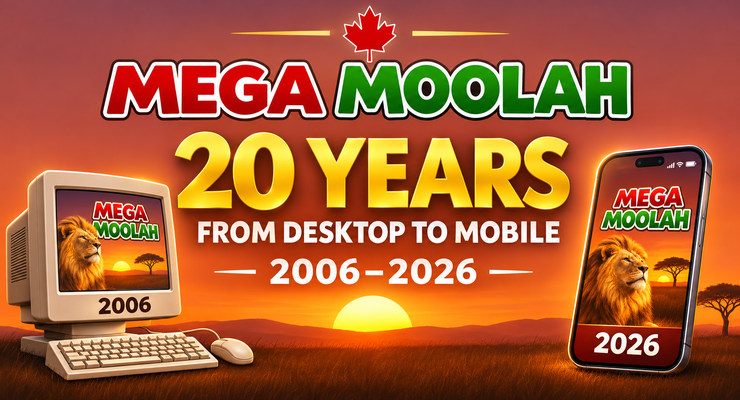
Online casino games rarely get to celebrate a twentieth birthday. Mega Moolah is an exception. It arrived in November 2006 with a safari backdrop, a handful of animal symbols and a jackpot wheel that made its name. Two decades later, the graphics feel unmistakably old-school — but the game still has a place in conversations about the biggest jackpots ever paid. In Canada, that story has a particularly memorable chapter.

What was so special about a safari slot?
Look at the original game through modern eyes and there is surprisingly little to explain. Five reels. Twenty-five paylines. A lion, a few other familiar animals and a jackpot wheel. In an industry that constantly introduces new mechanics and visual effects, Mega Moolah looks like something from a different age.
Its lasting idea was the progressive network. A share of eligible wagers contributes to growing jackpot pools, with four tiers — MINI, MINOR, MAJOR and MEGA. A qualifying spin can trigger the bonus wheel, which awards one of those prizes. The outcome is random. Nothing about a long-running jackpot makes a win due.
That design proved portable. As casino play moved from desktop screens to smartphones, the concept remained recognizable even when the technology around it changed.
Three moments that made the name bigger than the game
The story took a leap beyond casino circles on 6 October 2015. Jon Heywood won a Mega Moolah prize worth €17,879,645 at Betway. Guinness World Records documented the payout, and a slot that had already been running for almost nine years suddenly had a headline recognizable around the world.
In September 2018, a player at Grand Mondial landed roughly €18.9 million while using an Android phone. By then, mobile gaming was no longer a footnote to the online casino business. It had become part of its biggest stories.
The Mega Moolah network record moved again in April 2021 with a win of about €19.43 million on Absolootly Mad Mega Moolah. That jackpot belongs to the wider progressive family, not to the original safari-themed game. Keeping those two histories separate matters.
Canada’s C$20-million moment
Canada has a landmark of its own. On 30 January 2019, Zodiac Casino announced that a player identified as E. O. had won more than C$20 million on Mega Moolah. Casino Rewards, the casino network, published the winner’s story.
The number is striking enough without dressing it up. It was a Canadian-dollar prize, and it should not be compared with euro or sterling jackpots as though all three currencies had the same value. Different historical records also report slightly different precise figures for the payout, so “more than C$20 million” is the most useful and reliable way to describe it here.
What the result shows is not a pattern anyone can exploit. It shows how a shared progressive jackpot can make news thousands of kilometres away from the game’s original development team. Our Mega Moolah winners archive follows this and other major payouts, including wins linked to the original slot and its successors.
From Microgaming to a new generation of games
Some games survive by changing beyond recognition. Mega Moolah took a different route: it kept the familiar name and let the surrounding world evolve.
The key business handover happened in May 2022, when Games Global officially launched after acquiring Microgaming’s game distribution business, selected intellectual property and progressive jackpot network. Since then, additional titles have carried the Mega Moolah name into different styles of play, including Book of Mega Moolah and Mega Moolah Megaways.
A name on two games does not mean the games work the same way. Features, return-to-player figures, markets and availability can differ by title and casino. Our guide to the Mega Moolah series sets out the main variations.
The Canada of 2026 is not the Canada of 2006
For today’s Canadian reader, the biggest change may not be technological at all. It is provincial. Casino availability and regulation depend on where a player is physically located, and a casino’s international brand name is not proof that every version of its game catalogue is permitted across the country.
Ontario has a regulated private iGaming market and an official directory of authorized gaming websites. Alberta opened its regulated private market in July 2026, under provincial arrangements overseen by the AGLC and the Alberta iGaming Corporation. Québec has its own framework, with Loto-Québec identifying its own site as the province’s legal online casino provider.
That patchwork matters more than an impressive jackpot counter. Readers who want to know whether a specific Mega Moolah title can be played in their province need to check the current catalogue and provincial authorization, not rely on an operator’s history or an old promotion.
The right way to remember a jackpot legend
There is a reason the original lion has lasted this long. Mega Moolah is easy to recognize, and its record of exceptional wins tells a genuine story about how the online casino industry grew up. Even the June 2025 win of about £11.5 million at Betfred served as a reminder that the original slot could still draw headlines after nearly two decades.
But a twentieth anniversary is a milestone, not a prediction. Progressive jackpots are rare, random outcomes. A previous winner, a larger displayed pool or another player’s small stake cannot tell anyone when the next Mega prize will land. That distinction is worth keeping as clearly in view as the big numbers themselves.